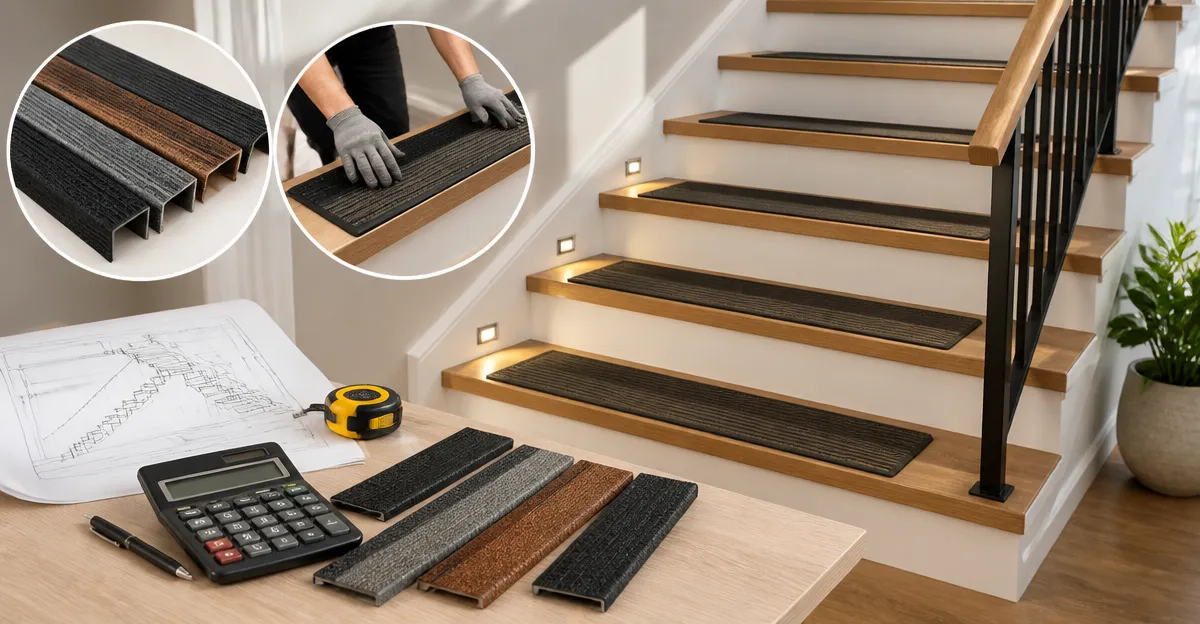
How Much Does It Cost to Install Non‑Slip Stair Treads Per Stair? Complete Installation & Price‑Per‑Step Guide
Introduction
One often overlooks the financial implications of improving stair safety until a slip occurs. This guide explains the variables that affect the cost of installing non‑slip stair treads on a per‑step basis. Readers will learn how to estimate material expenses, labor requirements, and long‑term value. The information is presented in a professional tone suitable for homeowners, property managers, and renovation professionals.
Background and Context
Non‑slip stair treads are engineered to increase friction between a foot and a stair surface, thereby reducing the likelihood of falls. They are commonly fabricated from polyester, TPE, or TPU backed with adhesive technologies such as TPR or self‑adhesive films. The market offers products ranging from budget‑friendly options to premium designs that incorporate noise‑reducing layers and decorative patterns. Understanding the construction of each tread helps one to compare cost against performance.
Understanding Non‑Slip Stair Treads
One of the primary performance indicators is the slip‑resistance rating, which is achieved through textured surfaces and high‑grip backing. For example, the COSY HOMEER Stair Treads employ a TPE non‑skid backing that remains effective even after repeated washing. Another critical factor is durability; the KOOTETA Stair Treads feature a polyester surface with a three‑layer construction that resists wear and noise. Finally, ease of installation influences overall cost because a product that can be applied without professional tools reduces labor expenses.
Manufacturers also differentiate their offerings by providing optional accessories such as extra adhesive tape, cutting guides, or landing pads. The MBIGM Carpet Stair Treads include a non‑permanent adhesive that permits repositioning without residue, which is valuable for renters. The Dayacoco Stair Treads emphasize noise reduction through high‑density wool blends, while the ComfyInLove Stair Treads highlight a washable polyester material that maintains grip after multiple cycles. These distinctions allow consumers to align product attributes with budgetary constraints.
Calculating Installation Cost Per Stair
The first step in budgeting is to determine the number of treads required for a given staircase. Most residential stairs have a uniform tread width of 8‑10 inches and a depth of 30‑32 inches; the products listed all measure 8" × 30", which matches standard dimensions. Multiply the total number of steps by the price per pack divided by the quantity of treads per pack to obtain a material cost per step. For instance, the COSY HOMEER pack provides 15 treads at $69.99, resulting in a material cost of approximately $4.67 per step.
Labor costs vary by region but typically range from $30 to $60 per hour for a skilled installer. Because most peel‑and‑stick treads require less than five minutes per step, the labor component per step averages $2.50 to $5.00. Adding a modest contingency of 10 % for unexpected surface preparation yields a total estimated cost per stair that falls between $7.50 and $12.00 for mid‑range products. Premium options with additional noise‑reduction layers or decorative finishes may increase the per‑step cost by $2‑$3.
Product Recommendations
For homeowners seeking a balance of safety, durability, and price, the COSY HOMEER Stair Treads are a strong candidate. They are rated 4.6 / 5.0 by over 8,500 reviewers, feature a washable non‑slip surface, and include a 24‑hour customer‑service guarantee. The pack price of $69.99 translates to a competitive per‑step cost while delivering a low‑profile design that does not interfere with door operation.
The KOOTETA Stair Treads excel in noise reduction and provide a TPR self‑adhesive that is gentle on wood yet firmly grippy. With a rating of 4.6 / 5.0 from 3,268 reviewers and a price of $39.99 for 15 treads, the material cost per step is only $2.67, making it an economical choice for multi‑family dwellings. Their ability to be machine‑washed adds long‑term value for pet owners.
The MBIGM Carpet Stair Treads offer a three‑layer construction that combines a polyester face, nonwoven buffer, and TPU bottom. Priced at $41.99 for 15 treads and holding a 4.6 / 5.0 rating from 8,686 reviews, they provide reliable anti‑skid performance without a permanent adhesive, which is ideal for renters or homes with delicate flooring.
The Dayacoco Stair Treads are the most affordable option at $24.99 per pack, yet they still achieve a 4.4 / 5.0 rating from 761 reviewers. Their high‑density wool blend reduces stair‑step noise by approximately 20 %, a benefit for households with infants or home‑office environments. Finally, the ComfyInLove Stair Treads combine a strong TPE backing with a washable polyester face for $25.99 per pack, delivering a solid blend of durability and ease of maintenance.
Comparison and Selection Guide
When selecting a non‑slip tread, one should compare price, rating, material composition, and additional features such as washability or noise reduction. Budget‑focused buyers may prioritize the Dayacoco or ComfyInLove options, which cost under $30 per pack while still receiving four‑star ratings. Safety‑critical applications, such as homes with elderly residents, benefit from the higher‑grade backing found in COSY HOMEER and KOOTETA products. Renters who need a removable solution should consider MBIGM, which advertises a non‑permanent adhesive that leaves no residue.
Best Practices & Tips
Before applying any tread, one should thoroughly clean the stair surface with a vacuum and a mild detergent to remove dust, grease, or previous finishes. A clean substrate ensures optimal adhesion and prevents premature lifting. After installation, press each tread firmly for at least 30 seconds to activate the adhesive layer; this step reduces the likelihood of edge curling.
For irregular stair dimensions, it is advisable to cut the tread with sharp scissors or a utility knife, following the manufacturer’s guidelines. Most products, including the KOOTETA and ComfyInLove lines, are designed with a high‑stability creasing technology that tolerates trimming without delamination. Periodic maintenance, such as vacuuming and spot‑cleaning, extends the life of the tread and preserves its slip‑resistant properties.
Frequently Asked Questions
Can non‑slip treads be used on carpeted stairs?
Most peel‑and‑stick treads are intended for smooth surfaces such as wood, tile, marble, or glass. Applying them to carpeted stairs may reduce adhesion and is not recommended by manufacturers.
Do the adhesives damage hardwood floors?
The products highlighted use non‑permanent adhesives that are formulated to release without leaving residue or harming the underlying finish when removed according to the instructions.
How often should the treads be cleaned?
Regular vacuuming removes dust and pet hair, while a gentle machine wash or hand wash can be performed according to the care guidelines provided by each brand.
Is professional installation necessary?
Professional installation is optional because each tread is designed for a DIY peel‑and‑place application that typically requires less than five minutes per step.
What is the expected lifespan of a stair tread?
When maintained properly, most polyester‑based treads retain their slip‑resistance and appearance for three to five years, after which wear may necessitate replacement.
Conclusion
One can achieve a safe, quiet, and aesthetically pleasing staircase by selecting the appropriate non‑slip tread and budgeting for material and modest labor costs. By evaluating price per step, adhesive type, and additional features such as washability, homeowners can make an informed decision that aligns with their safety priorities and financial constraints. The calculations presented in this guide provide a transparent framework for estimating total installation expenses. Ultimately, investing in quality stair treads reduces the risk of falls and protects the underlying stair material for years to come.
Products Featured in This Guide
COSY HOMEER Stair Treads
Price: $69.99 Rating: 4.6/5.0 (8,525 reviews)
Featured for its washable TPE non‑skid backing, low‑profile design, and strong customer‑service guarantee.
KOOTETA Stair Treads
Price: $39.99 Rating: 4.6/5.0 (3,268 reviews)
Featured for its premium polyester surface, TPR self‑adhesive technology, and machine‑washable construction.
MBIGM Carpet Stair Treads
Price: $41.99 Rating: 4.6/5.0 (8,686 reviews)
Featured for its three‑layer construction, non‑permanent adhesive, and strong anti‑skid performance.
Dayacoco Stair Treads
Price: $24.99 Rating: 4.4/5.0 (761 reviews)
Featured for its high‑density wool blend that reduces stair noise and its budget‑friendly price point.
ComfyInLove Stair Treads
Price: $25.99 Rating: 4.5/5.0 (80 reviews)
Featured for its strong TPE backing, washable polyester material, and inclusion of extra adhesive tape for older stairs.